Are you looking for ways to wisely navigate the emotional waves that arise in daily relationships? Understand that subjective interpretation leads to emotions, and learn practical emotion management methods to protect your inner peace by quantifying emotional intensity. Set your own relationship standards to reduce stress and foster healthier interactions.

Navigating Emotional Turmoil in Relationships: Why Does it Feel So Hard?
In our daily lives, we interact with various individuals, experiencing a wide spectrum of emotions. Sometimes, a conversation or a specific situation can leave us feeling uneasy, or even disrespected, leading to deep contemplation. These emotional waves often strain relationships and ultimately lead to personal exhaustion. The question of why such emotions arise, and how to maintain our inner peace amidst such turmoil, is a common struggle for many. Discomfort in relationships frequently stems not from the objective situation itself, but from how we perceive and interpret it. Understanding this difference in interpretation is the foundational step towards effective emotion management.

How Interpretation Shapes Our Emotions: Understanding the Mind's Mechanism
It's often easy to believe that our emotions are a direct consequence of external events. However, emotions actually form through a complex process: 'Situation → Interpretation → Emotion.' This means that even the same situation can trigger entirely different emotional responses depending on how an individual perceives and assigns meaning to it. Grasping this fundamental mechanism of the mind is crucial for effective emotion management. To objectively gauge the intensity of our feelings, we can utilize a scale from 0 to 10:
- Level 0-2: Minimal impact, easily dismissed or ignored.
- Level 3-4: Slight discomfort, manageable with a brief response or a moment of reflection.
- Level 5-6: Distinct emotions begin to surface, signaling a need to acknowledge and regulate them.
- Level 7-8: Stress levels are high, indicating it's time to create some distance or objectively reassess the situation.
- Level 9-10: Emotional agitation is severe and difficult to control, requiring immediate disengagement and self-protection.
※ This post contains affiliate links. I may earn a commission at no extra cost to you.

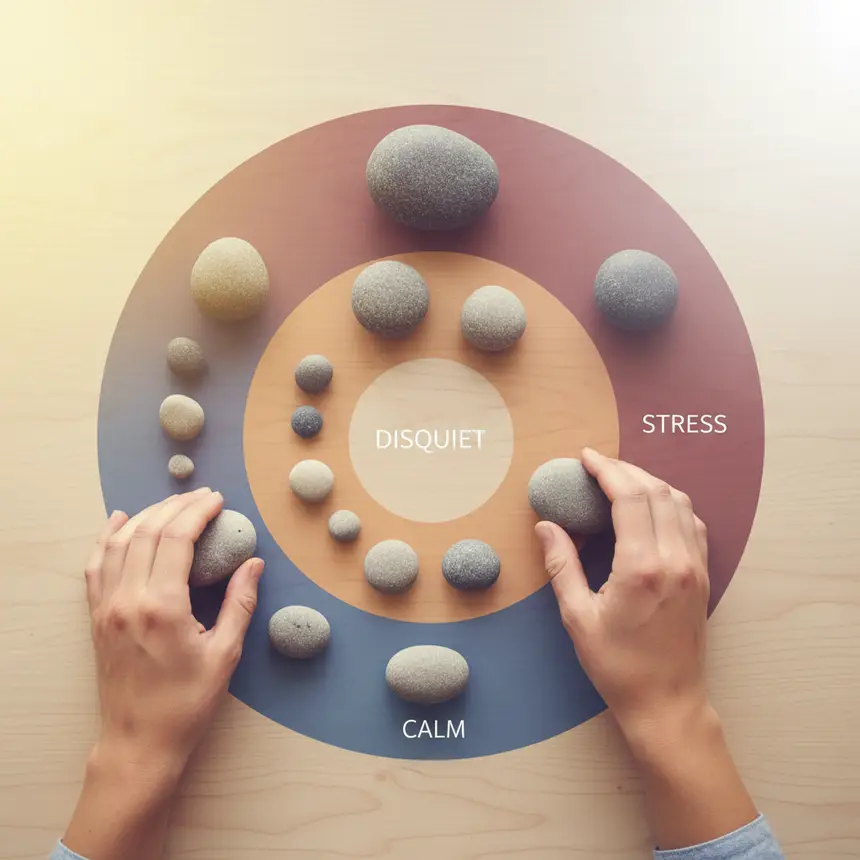
Reducing Relationship Stress by Setting Your Own Emotional Standards
Once you understand the emotional scale, the next step is to establish your own relationship standards to minimize unnecessary relationship stress. For instance, you might set a rule that if your emotional score rises above 6 during a conversation, you will no longer strive to make the other person understand or force the conversation to continue. This isn't about avoiding conflict entirely, but rather about protecting your mental well-being and wisely managing your boundaries for healthier interactions. By implementing such standards, you can reduce unnecessary emotional drain and positively influence the dynamics of your interactions.
- If your emotional score exceeds a certain level (e.g., 6), take a break from the conversation and recenter yourself.
- Focus on objectively assessing the situation rather than making emotional judgments when deciding your next action.
- Remember, you can only truly understand and respect others more clearly when you are in a stable state yourself.
Frequently Asked Questions
Q. Won't rating emotions feel too mechanical?
A. It might feel a bit unfamiliar at first, but rating emotions is a tool to objectively recognize and manage them. It's not about suppressing feelings, but rather understanding their intensity to find appropriate responses. With consistent practice, your ability to understand and cope with emotional flows will naturally improve.
Q. Should I apply these standards to all my relationships?
A. Rather than applying these standards uniformly to all relationships, they are particularly useful in situations with high relationship stress or in recurring uncomfortable interactions. In intimate relationships, apply them flexibly, but consider these standards when you feel emotionally drained.
Q. How should I consider the other person's emotions?
A. Managing your own emotions is a form of self-care and does not mean disregarding others' feelings. On the contrary, when you are in a stable state, you can respond to others' emotions in a healthier and more constructive way. It's important to respect each other's emotions based on mutual respect.
Q. What can I do immediately when I struggle to regulate my emotions?
A. When emotional intensity rises, it's effective to stop what you're doing and take several deep breaths. Create some space to separate from the current situation and your feelings, and if possible, step away or change your environment. Afterward, use the emotion scale provided to objectively assess your current state.